




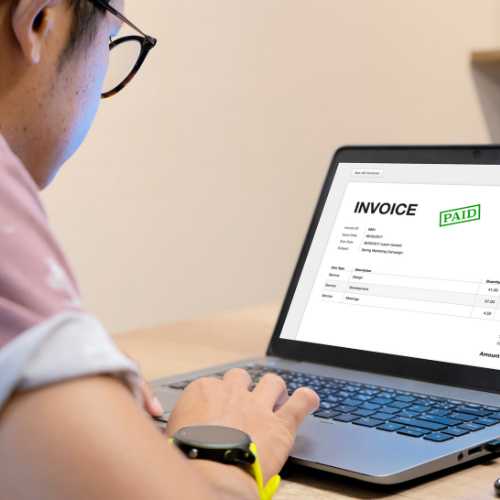


The Hidden Cost of Doing Invoicing by Hand
As the company added customers, branches and product lines, invoicing became a chain of manual steps. Sales staff typed orders into a spreadsheet, finance retyped them into an accounting package, and invoices were exported to PDF and emailed one by one. Corrections meant starting the chain again. Under BIR rules, covered taxpayers are expected to issue structured electronic invoices by 31 December 2026 and hold a Permit to Issue, so adding more manual checks on top of the old process was not a workable plan.
- Repeated Data Entry: The same order details were typed into more than one file or system.
- Emailed PDF Invoices: Documents were sent and tracked individually, which took time and invited mistakes.
- Spreadsheet Reconciliation: Finance matched orders, invoices and payments by hand at the end of each period.
- Slow Correction Cycles: Errors found after issuing an invoice required re-approval and reissuing from scratch.
- Dependence on Key People: A few experienced staff held the knowledge needed to prepare invoices correctly.
Automation Steps That Remove the Repetitive Work
Single Point of Data Entry
Capture order and customer details once, then reuse them in the accounting record and the invoice, so staff stop retyping the same information.
Automatic Field Mapping
Match accounting fields to the structured invoice format automatically, so each invoice is prepared from the source record rather than assembled by hand.
Built-In Validation
Check mandatory fields, tax IDs, VAT classifications and totals before an invoice is issued, so errors are caught at the start instead of after the customer receives it.
Batch Preparation and Delivery
Prepare and route approved invoices in batches, with JSON currently preferred by the BIR for structured data, and deliver customer copies through configured channels once permit and certification requirements are met.
Status and Exception Dashboard
Show which invoices were processed, which are pending and which need attention, so staff focus on exceptions instead of checking every document.
Linked Corrections and Records
Handle corrections and credit notes through linked documents, and keep references between e-invoices and source transactions to speed up lookups and reconciliation.
How Advintek Reduced the Manual Steps
Advintek’s approach starts by mapping where staff touch an invoice and removing the steps that add no value. The implementation is tailored to the company’s accounting software, available interfaces and applicable business requirements.
- Map Every Manual Step in Invoicing
- Define the Source of Truth for Invoice Data
- Connect Sales and Accounting Records
- Configure Validation and Submission Rules
- Test Volume, Corrections and Failure Handling
- Monitor Processing Status and Staff Workload
What Less Manual Work Can Mean for a Finance Team
Removing repetitive steps can help finance teams spend more time on review and less on retyping. For a growing Philippine company, the value lies in a process that scales with volume while continuing to use its established accounting environment.
- Less Re-Keying: Reuse source data instead of retyping orders and customer details.
- Fewer Emailed Attachments: Reduce one-by-one document handling and tracking.
- Shorter Reconciliation: Match invoices to orders and payments with fewer manual checks.
- Faster Corrections: Resolve errors through linked credit notes rather than restarting the chain.
- Less Reliance on Individuals: Keep invoice rules in the workflow, not only in people’s heads.
- Organized Invoice Records: Maintain accessible e-invoice records for reporting, reviews and compliance documentation.
Why Growing Companies Work with Advintek
Let Your Team Work on Exceptions, Not Retyping
Philippine companies can prepare for BIR e-invoicing by connecting their sales and accounting records to configured electronic invoice workflows. Advintek helps businesses map invoice data, configure validation, support electronic invoice processing and organize financial records, without requiring a complete software replacement. To go deeper on the rules, see our guides on e invoicing details and bir e-invoicing requirements. Final BIR permits, certification and system requirements must be confirmed directly with the BIR.
Explore Our Case Studies

BIR EIS registration is the mandatory gateway every covered taxpayer must complete before issuing a single electronic invoice under Revenue Regulation No. 11-2025. The BIR EIS registration process encompasses three sequential stages: EIS certification requirements review, PTI (Permit to Issue) application through BIR ORUS, and sandbox testing before live activation. This guide provides a complete […]

BIR e-invoice correction — the process of fixing errors in invoices already submitted to the BIR Electronic Invoicing System — is one of the most operationally critical aspects of EIS compliance under Revenue Regulation No. 11-2025. Unlike paper invoices where a stamp or manual correction could be made directly, BIR e-invoice correction requires formal cancellation […]

The relationship between BIR ATP and E-Invoicing — the Authority to Print and the new Electronic Invoicing System — is one of the most operationally significant compliance questions under Revenue Regulation No. 11-2025. BIR ATP e-invoicing coexistence during the transition period requires careful management to avoid penalties for issuing invalid printed invoices after EIS go-live. […]

BIR e-invoicing for small businesses under Revenue Regulation No. 11-2025 is not immediately mandatory in the initial phase — the December 31, 2026 deadline applies only to taxpayers in the RMC 98-2026 covered list (Large Taxpayers, Top Withholding Agents and registered exporters). However, BIR e-invoicing for small businesses landscape is changing rapidly, and proactive preparation […]

BIR EIS integration is the technical foundation of every covered taxpayer’s BIR Electronic Invoicing System compliance programme. A well-designed BIR EIS integration architecture ensures real-time or four-hour invoice submission, error handling, EIS confirmation tracking and five-year record archiving — all aligned with BIR RR 11-2025 requirements. This guide focuses on the technical architecture of BIR […]

Understanding BIR E-Invoicing Cost Guide 2026 is one of the first practical questions every business must answer when planning for RR 11-2025 compliance. BIR e-invoicing cost varies significantly by business size, invoice volume, integration complexity and the type of e-invoicing solution chosen — from affordable cloud SaaS platforms to full-service ESP-managed implementations for large enterprises. […]
