




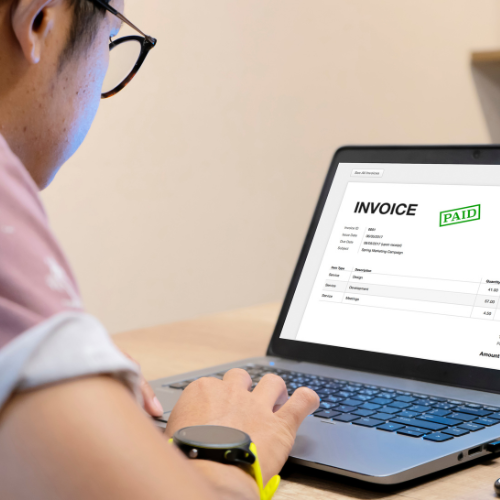


Key Business Challenges in Improving Financial Efficiency Through BIR E-Invoicing
As transaction volumes grew, managing invoices and financial records through manual processes became increasingly demanding for the business. Disconnected applications, repeated data entry, and time-consuming reconciliation created operational challenges for the finance team. The company needed an e-invoicing approach that could support applicable BIR requirements while improving invoice accuracy, reporting efficiency, and day-to-day financial operations.
- Manual Invoice Processing: Repeated data entry and document handling increased invoice preparation time and staff workload.
- BIR E-Invoicing Requirements: The business needed to prepare its invoicing workflows for applicable Philippine electronic invoicing requirements.
- Disconnected Financial Systems: Separate applications made it difficult to maintain consistent invoice data and transaction records.
- Invoice Errors and Reconciliation Delays: Manual processing increased data discrepancies, corrections, and the effort required to reconcile financial records.
- Limited Financial Visibility: The finance team needed organized invoice records and clearer status tracking for reporting and review.
Key Features That Supported Better Financial Efficiency
We are a compliance-driven e-Invoicing provider, delivering secure, LHDN-approved digital certificate solutions to safeguard your documents and ensure end-to-end regulatory trust.
Automated Invoice Data Preparation
Prepare invoice information from connected business applications for electronic processing, reducing repetitive data entry and helping finance teams manage billing activities with greater consistency and accuracy.
Accounting and ERP Integration
Connect compatible accounting, ERP, and operational systems with e-invoicing workflows, enabling businesses to retain existing applications while improving invoice data exchange and overall operational coordination.
Invoice Validation and Error Checks
Identify missing or inconsistent invoice information through validation checks before submission, helping finance teams correct potential errors early, reduce avoidable rework, and maintain more accurate transaction records.
Invoice Status Monitoring
Track invoice progress, pending actions, and processing exceptions through centralized information, giving finance teams better visibility and helping them manage invoicing activities more efficiently.
Organized Digital Invoice Records
Maintain structured e-invoice records for easier retrieval, supporting financial reconciliation, reporting, documentation, and internal reviews while improving consistency across transaction records.
Philippine BIR Compliance Support
Configure and integrate e-invoicing workflows around applicable Philippine BIR requirements and business needs, helping teams prepare invoice processes for relevant compliance obligations.
How Advintek Delivered an Integrated E-Invoicing Solution for Philippine Businesses
Advintek reviews financial workflows and configures e-invoicing around existing applications, invoice data, system integrations, validation needs, and recordkeeping requirements for efficient business operations.
- Integration with Existing Business Systems
- Invoice Data Mapping and Preparation
- Automated Invoice Validation and Error Checks
- Electronic Invoice Transmission Support
- Invoice Status and Exception Monitoring
- Digital Invoice Records and Reporting
- Configuration for Applicable BIR Requirements
Measurable Business Outcomes Achieved Through Financial E-Invoicing Automation
Advintek connects business systems, maps invoice data, and prepares structured documents. Automated validation identifies errors before transmission. Teams can monitor invoice statuses, manage exceptions, maintain digital records, access reports, and configure workflows around applicable Philippine BIR requirements.
- Reduced Manual Processing: Minimize repetitive invoice entry and administrative tasks across daily billing operations.
- Improved Invoice Accuracy: Identify discrepancies early and reduce avoidable corrections before invoice submission.
- More Efficient Reconciliation: Simplify comparisons between invoices and financial transactions for faster financial reviews.
- Better Reporting Efficiency: Retrieve organized invoice data for financial reviews.
- Improved Financial Workflow Management: Coordinate invoicing through connected systems and structured records.
- Greater Invoice Visibility: Track pending invoices and resolve exceptions promptly.
Why the Business Selected Advintek as Its E-Invoicing Partner
Transform Financial Efficiency with BIR-Ready e-Invoicing
The shift toward E-invoicing allows Philippine businesses to review their billing processes, organize financial information, and prepare for applicable BIR requirements. An appropriately configured solution can help reduce manual work, improve invoice data consistency, and support more efficient financial reporting. Advintek helps businesses integrate electronic invoicing with existing applications, supporting more organized invoice processing and improved visibility across financial workflows. With a future-ready property invoicing software platform and advanced contractor billing Malaysia capabilities, the business is now equipped to support expansion, improve project efficiency, and confidently adapt to evolving regulatory requirements.
Explore Our Case Studies

PEPPOL vs XRechnung is a comparison that confuses many German businesses because the two terms operate at different levels: PEPPOL is a network and a format standard; XRechnung is a German invoice format. Comparing PEPPOL vs XRechnung directly is like comparing a postal network to a letter format — they are not mutually exclusive. An […]

The BIR’s Electronic Invoicing/Receipting System represents a fundamental shift in how Philippine businesses document and report their transactions. Rather than maintaining invoice records internally for periodic audit review, covered taxpayers transmit invoices to the government electronically in accordance with applicable requirements. This shift changes not just the technology of invoicing but also the compliance relationship […]

With the December 31, 2026 BIR e-invoicing deadline approaching, many Philippine businesses are in the final stages of their compliance projects — integrating systems, applying for PTI approvals, and training staff. However, BIR E-Invoicing Mistakes can delay your go-live date, expose your business to BIR scrutiny, or leave you technically compliant but operationally unprepared for […]

Technical integration between a business’s existing billing and accounting systems and the BIR Electronic Invoicing/Receipting System (EIS) is the core engineering challenge of Philippines e-invoicing compliance. For many covered taxpayers, the integration project — not the regulatory analysis — is the longest lead-time item in the compliance journey. Getting the integration right means your EIS […]

When the BIR issued Revenue Regulations No. 026-2025 (RR 026-2025), it moved the Philippines E-Invoicing Deadline for Group 1 taxpayers from March 14, 2026, to December 31, 2026. This nine-and-a-half-month extension gave covered businesses additional time to prepare for compliance. Understanding precisely what this regulation changed, who it applies to, and what the updated obligations […]

Revenue Regulations No. 11-2025 and RMC 98-2026 establish a compliance framework for the Philippines’ e-invoicing mandate, with December 31, 2026, serving as a key deadline for Group 1 taxpayers. This BIR E-Invoicing Checklist provides covered businesses with a structured, actionable path toward EIS compliance, guiding finance and IT teams through essential preparation, system integration, testing, […]
